
How Much Does Cloud Hosting Cost?
Cloud hosting costs range from $5 per month for basic virtual servers to $500+ per month for enterprise-grade infrastructure. A typical small business website runs $40-$150 monthly, while high-traffic applications can exceed $1,000 per month. The final price depends on your compute resources (vCPU and RAM), storage needs, bandwidth consumption, and whether you choose self-managed or fully managed services. Here's exactly what you'll pay for cloud hosting.
How Much Do Cloud Hosting Plans Cost?
Cloud hosting operates on several pricing models that affect your monthly bill differently. Understanding these models helps you choose the most cost-effective option for your workload.
| Pricing Model | How It Works | Typical Savings | Best For |
|---|---|---|---|
| On-Demand/Pay-As-You-Go | Pay per hour or second with no commitment | None (baseline pricing) | Variable workloads, testing, unpredictable traffic |
| Reserved Instances | Commit to 1-3 years for specific resources | Up to 72% off on-demand | Stable, predictable workloads |
| Savings Plans | Commit to hourly spend across flexible resources | 30-60% off on-demand | Growing businesses with steady baseline usage |
| Spot/Preemptible Instances | Bid on unused capacity (can be interrupted) | Up to 90% off on-demand | Fault-tolerant batch processing, CI/CD |
Entry-level cloud servers from major providers start at $5-$8 per month for 1 vCPU and 1GB RAM. A general-purpose instance with 2 vCPUs and 4GB RAM typically costs $0.10-$0.12 per hour on-demand, translating to approximately $70-$85 monthly if running continuously. Reserved pricing for the same configuration drops to around $0.04 per hour, or roughly $30 monthly with a one-year commitment.
Cloud Hosting Provider Pricing Compared
The four major cloud providers-AWS, Azure, Google Cloud, and Oracle Cloud-hold approximately 65% of the worldwide cloud infrastructure market. Each offers comparable core services but with different pricing structures and discount mechanisms.
| Provider | Market Share | On-Demand (2 vCPU, 4GB RAM) | Reserved (1-year) | Free Tier |
|---|---|---|---|---|
| AWS | 29-32% | $0.10-$0.12/hour (~$75/mo) | ~$0.04/hour (~$30/mo) | 12 months limited |
| Microsoft Azure | 20-23% | $0.09-$0.11/hour (~$70/mo) | ~$0.04/hour (~$30/mo) | $200 credit + 12 months |
| Google Cloud | 12-13% | $0.08-$0.10/hour (~$65/mo) | ~$0.035/hour (~$26/mo) | $300 credit for 90 days |
| Oracle Cloud | 3% | $0.07-$0.09/hour (~$55/mo) | ~$0.03/hour (~$22/mo) | Always Free tier |
Google Cloud applies sustained-use discounts automatically, providing up to 30% off after 25% monthly usage without requiring manual configuration. AWS and Azure require you to actively configure Savings Plans or Reserved Instances to achieve similar savings.
Cloud Hosting Design and Setup Cost
Setting up cloud hosting infrastructure ranges from free (DIY) to several thousand dollars for professional architecture design.
| Setup Approach | Cost Range | What's Included |
|---|---|---|
| DIY with provider console | $0 | Basic server deployment, default configurations |
| DIY with infrastructure-as-code | $0 (+ learning time) | Automated, repeatable deployments |
| Managed cloud hosting platform | $14-$50/month (included) | Pre-configured servers, control panel, basic setup |
| Freelance cloud architect | $500-$5,000 | Custom architecture, security configuration, documentation |
| Agency/consulting firm | $5,000-$50,000+ | Enterprise architecture, compliance, migration planning |
Managed cloud hosting providers like Cloudways ($14/month starting), Hostinger Cloud ($6.99/month with multi-year commitment), or Liquid Web ($159/month) include setup assistance and pre-configured environments, eliminating the need for cloud architecture expertise.
Cloud Hosting Development and Configuration Cost
Beyond basic setup, custom development and configuration add to your cloud hosting investment.
| Configuration Task | DIY Time | Professional Cost |
|---|---|---|
| Basic server setup | 1-2 hours | $100-$200 |
| Load balancing configuration | 2-4 hours | $200-$500 |
| Auto-scaling setup | 4-8 hours | $500-$1,500 |
| Database cluster deployment | 4-8 hours | $500-$2,000 |
| CI/CD pipeline integration | 8-20 hours | $1,000-$5,000 |
| Security hardening | 4-16 hours | $500-$3,000 |
| Disaster recovery configuration | 8-24 hours | $1,500-$5,000 |
Developer hourly rates for cloud infrastructure work typically range from $50-$150 for freelancers and $150-$300+ for specialized consultants or agencies. A complete professional setup for a small business application typically costs $1,000-$5,000.
Cloud Storage Cost
Storage pricing varies by type, performance tier, and access frequency.
| Storage Type | AWS S3/EBS | Azure Blob/Disk | Google Cloud Storage | Use Case |
|---|---|---|---|---|
| Standard object storage | $0.023/GB/mo | $0.018/GB/mo | $0.020/GB/mo | Frequently accessed files |
| Infrequent access | $0.0125/GB/mo | $0.01/GB/mo | $0.01/GB/mo | Backups, archives accessed monthly |
| Archive/cold storage | $0.004/GB/mo | $0.002/GB/mo | $0.004/GB/mo | Long-term archives, compliance |
| SSD block storage | $0.10/GB/mo | $0.12/GB/mo | $0.08/GB/mo | Database volumes, high IOPS |
| HDD block storage | $0.05/GB/mo | $0.04/GB/mo | $0.04/GB/mo | Large files, sequential access |
Storing 1 terabyte of standard data costs approximately $20-$23 per month across all major providers. Storage rarely represents the largest portion of cloud bills-compute and data transfer typically contribute more significantly to total costs.
Cloud Hosting Bandwidth and Data Transfer Cost
Data transfer costs are where cloud pricing becomes complicated and where unexpected bills often originate.
| Transfer Type | AWS | Azure | Google Cloud | Notes |
|---|---|---|---|---|
| Data ingress (upload) | Free | Free | Free | All providers |
| Data egress (first 100GB/mo) | Free | Free | Free | Included allowance |
| Data egress (1-10TB) | $0.09/GB | $0.087/GB | $0.12/GB | Standard internet |
| Data egress (10-50TB) | $0.085/GB | $0.083/GB | $0.11/GB | Volume discount |
| Inter-region transfer | $0.02/GB | $0.02/GB | $0.01/GB | Between data centers |
| Same-region (different AZ) | $0.01/GB | $0.01/GB | $0.01/GB | Often overlooked |
Egress fees can account for 10-15% of total cloud costs. For a website serving 10TB of data monthly, expect $870-$1,200 in bandwidth charges alone. Real-world cases show teams paying $3,500-$6,750 monthly in egress fees that exceeded their compute costs.
Hidden Costs of Cloud Hosting
Several cost categories frequently surprise cloud hosting customers:
Data egress and transfer fees represent the most common unexpected expense. Every gigabyte leaving a cloud provider's network incurs charges, including data sent to end users, transferred between regions, or moved to other cloud providers. A company growing its user base can see egress costs rise from $200 to $3,500+ monthly within eight months without any infrastructure changes.
Inter-availability zone traffic adds up silently. Database servers communicating with application servers in different availability zones incur fees in both directions. Microservices architectures with frequent cross-zone communication generate substantial background charges even before any public traffic.
Support tiers range dramatically. Basic support is typically free, but business or enterprise support costs 3-10% of your monthly bill or a minimum fee of $100-$15,000+ monthly depending on the provider and tier.
NAT gateway charges apply when private instances access the internet. AWS charges $0.045 per hour plus $0.045 per GB processed, potentially adding $30-$100+ monthly for moderate traffic.
Load balancer costs run $15-$25 per month for Application Load Balancers plus $0.008 per LCU-hour, which can total $50-$200+ monthly for production workloads.
Managed database markup typically costs 20-40% more than running equivalent database software on standard compute instances.
Reserved instance underutilization occurs when committed capacity goes unused, wasting prepaid costs.
Snapshot and backup storage accumulates incrementally-old snapshots often persist forgotten, adding $50-$500+ monthly over time.
Cloud Hosting Cost Per Month: Real Examples
Example 1: Personal Blog or Portfolio Site
| Component | Monthly Cost |
|---|---|
| Managed cloud hosting (Hostinger Cloud) | $6.99 |
| Domain (included first year) | $0 |
| SSL certificate (included) | $0 |
| CDN (Cloudflare free tier) | $0 |
| Total | $6.99/month |
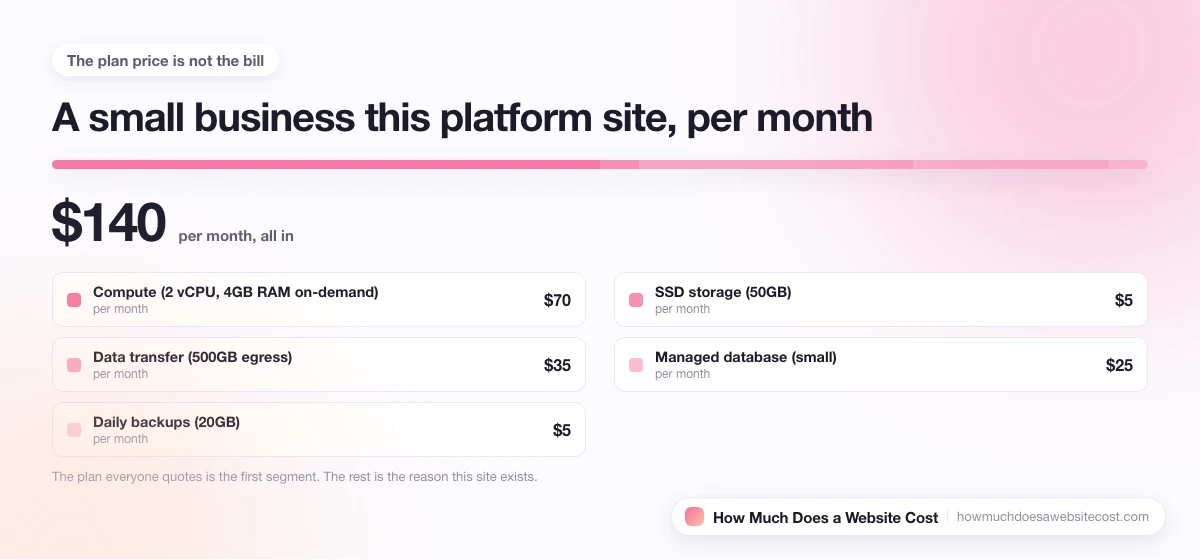
Example 2: Small Business Website (Self-Managed)
| Component | Monthly Cost |
|---|---|
| Compute (2 vCPU, 4GB RAM on-demand) | $70 |
| SSD storage (50GB) | $5 |
| Data transfer (500GB egress) | $35 |
| Managed database (small) | $25 |
| Daily backups (20GB) | $5 |
| Total | $140/month |
Example 3: Growing E-commerce Application
| Component | Monthly Cost |
|---|---|
| Compute (3 instances, reserved 1-year) | $90 |
| Load balancer | $25 |
| Managed database (production tier) | $150 |
| SSD storage (200GB) | $20 |
| Object storage (100GB) | $2.50 |
| Data transfer (2TB egress) | $180 |
| CDN | $50 |
| Monitoring and logging | $30 |
| Business support | $100 (minimum) |
| Total | $647.50/month |
Example 4: High-Traffic SaaS Application
| Component | Monthly Cost |
|---|---|
| Compute cluster (8 instances, mix of reserved/spot) | $400 |
| Auto-scaling additional capacity | $200 (variable) |
| Load balancing (multiple) | $75 |
| Managed database cluster | $500 |
| Redis cache cluster | $150 |
| Object storage (1TB) | $25 |
| Data transfer (10TB egress) | $850 |
| CDN (5TB) | $200 |
| Monitoring, logging, alerting | $100 |
| Enterprise support | $400 |
| Security tools (WAF, DDoS) | $100 |
| Total | $3,000/month |
Cloud Hosting vs Other Hosting Options
| Hosting Type | Monthly Cost | Scalability | Management | Best For |
|---|---|---|---|---|
| Shared Hosting | $3-$15 | None | Fully managed | Personal sites, small blogs |
| VPS Hosting | $5-$80 | Manual | Self-managed | Small business, developers |
| Managed cloud hosting | $14-$200 | Automatic | Managed | Growing businesses |
| Self-managed cloud (AWS/Azure/GCP) | $40-$500+ | Automatic | Self-managed | Technical teams, custom needs |
| Dedicated server | $100-$500+ | None | Self-managed | Consistent high performance |
| Enterprise cloud | $500-$10,000+ | Automatic | Various | Large organizations |
Cloud hosting advantages:
- Instant scalability to handle traffic spikes
- Pay only for resources consumed
- Global infrastructure availability
- Built-in redundancy options
- Access to managed services (databases, AI, analytics)
Cloud hosting disadvantages:
- Unpredictable costs from usage-based billing
- Complexity requiring cloud expertise
- Vendor lock-in through proprietary services
- Egress fees discouraging multi-cloud or migration
- Steeper learning curve than managed alternatives
How to Reduce Your Cloud Hosting Cost
Right-size your instances by analyzing actual utilization. Most cloud workloads are over-provisioned by 30-40%. Use provider tools like AWS Compute Optimizer or Azure Advisor to identify downsizing opportunities.
Commit to reserved capacity for predictable workloads. One-year reservations typically save 30-40% while three-year commitments save up to 72% compared to on-demand pricing.
Use spot instances for fault-tolerant workloads. Batch processing, CI/CD pipelines, and stateless applications can run on spot capacity at 60-90% discounts.
Implement auto-scaling to match capacity to demand. Scale down during off-peak hours and weekends to eliminate paying for idle resources.
Use a CDN to cache content at edge locations. Serving static assets from CDN networks dramatically reduces egress from your cloud origin servers.
Consolidate availability zones where high availability isn't critical. Inter-AZ data transfer charges add up across microservices and database replication.
Set up billing alerts and budgets to catch cost anomalies before they become expensive surprises. All major providers offer threshold notifications.
Review and delete unused resources monthly. Orphaned snapshots, unattached volumes, idle load balancers, and forgotten test instances accumulate costs.
Is Cloud Hosting Worth the Cost?
Cloud hosting is worth it if you:
- Need to scale resources up or down based on demand
- Want to avoid capital expenditure on hardware
- Require global infrastructure presence
- Need managed services for databases, AI, or analytics
- Have technical staff capable of cloud management
- Experience variable or unpredictable traffic patterns
Consider alternatives if you:
- Have consistent, predictable resource requirements
- Lack cloud expertise on your team
- Operate on a strict, fixed budget
- Transfer large amounts of data out of the cloud regularly
- Need simple hosting without infrastructure complexity
- Want completely predictable monthly costs
For businesses without cloud expertise, managed cloud hosting platforms offer a middle ground-cloud infrastructure benefits with simplified management and more predictable pricing. For those needing maximum control and flexibility with the budget to support it, direct cloud provider accounts provide unmatched capability at the cost of complexity.