
How Much Does Website Security Cost?
How much does website security cost? A basic website security setup costs $200-$500 per year for small sites, while comprehensive enterprise protection ranges from $5,000-$50,000+ annually. The total investment depends on your security layers: SSL certificates cost $0-$300/year, web application firewalls run $20-$500/month, and professional penetration testing adds $5,000-$100,000 per engagement.
Website security isn't a single product-it's a layered defense system. Each layer addresses different threats, from encrypting data in transit to detecting malicious code to testing for vulnerabilities. Understanding what each component costs helps you build protection that matches both your risk profile and your budget.
Here's the complete breakdown of website security costs, covering every component from free options to enterprise-grade protection.
Website Security Cost Overview
| Security Approach | Annual Cost | Protection Level | Best For |
|---|---|---|---|
| Basic/DIY | $0-$300 | Minimal | Personal blogs, hobby sites |
| Standard Protection | $300-$1,500 | Moderate | Small business websites |
| Professional Security | $1,500-$10,000 | Comprehensive | E-commerce, business-critical sites |
| Enterprise Security | $10,000-$100,000+ | Maximum | High-traffic sites, regulated industries |
The cost variance stems from several factors: your website platform, traffic volume, data sensitivity, compliance requirements, and whether you handle security in-house or outsource to specialists. A WordPress blog with contact forms has vastly different security needs than an e-commerce store processing credit cards.
SSL Certificate Costs
SSL/TLS certificates encrypt data between your website and visitors. They're mandatory for any site collecting user information and required for Google ranking benefits.
SSL Certificate Pricing by Type
| Certificate Type | Annual Cost | Validation Level | Best For |
|---|---|---|---|
| Free (Let's Encrypt) | $0 | Domain Validation | Personal sites, blogs |
| Domain Validation (DV) | $8-$100 | Basic | Small business sites |
| Organization Validation (OV) | $60-$200 | Business verified | E-commerce, professional sites |
| Extended Validation (EV) | $75-$1,000 | Extensive verification | Financial services, enterprises |
| Wildcard SSL | $50-$500 | Covers subdomains | Sites with multiple subdomains |
| Multi-Domain SSL | $22-$400 | Multiple websites | Agencies, multi-site businesses |
Free SSL certificates from Let's Encrypt provide the same encryption strength as paid options. The price difference reflects the validation process-paid certificates verify your business identity, which some industries require. Many hosting providers include free SSL with their plans, eliminating this cost entirely for basic sites.
When You Need Paid SSL
Domain Validation certificates suffice for most websites. Consider Organization or Extended Validation certificates if you're in financial services, healthcare, or e-commerce processing significant transaction volume. These display your verified company name, which can increase customer trust.
Web Application Firewall (WAF) Costs
A WAF filters malicious traffic before it reaches your website, blocking SQL injection, cross-site scripting, and other application-layer attacks.
WAF Pricing Comparison
| WAF Solution | Monthly Cost | Traffic Included | Best For |
|---|---|---|---|
| Cloudflare Free | $0 | Basic protection | Low-traffic sites |
| Cloudflare Pro | $20 | Advanced WAF rules | Professional sites |
| Cloudflare Business | $200 | Custom rulesets | E-commerce, agencies |
| Sucuri Basic | $17 | Unlimited bandwidth | WordPress sites |
| Sucuri Pro | $25 | Faster scanning | Business sites |
| AWS WAF | $26-$100+ | Pay per request | AWS-hosted applications |
| Enterprise WAF | $500-$10,000 | Custom | High-traffic sites |
Cloud-based WAFs like Cloudflare and Sucuri offer the most cost-effective protection for small to mid-size websites. Enterprise solutions from providers like AWS, Azure, or Akamai scale with traffic but can become expensive at high volumes-AWS WAF charges approximately $0.60 per million requests plus rule costs.
WAF Cost Factors
Traffic volume drives costs on usage-based platforms. A site receiving 10 million monthly requests would pay around $30/month on AWS WAF with basic rules. Adding bot control or advanced threat intelligence increases costs significantly-AWS Bot Control adds approximately $10/month plus $1 per million requests beyond the free tier.
Malware Scanning & Removal Costs
Malware scanning tools detect infections before they damage your site or spread to visitors. Removal services clean infected sites and restore normal operation.
Malware Protection Pricing
| Service Type | Cost | Frequency | Includes |
|---|---|---|---|
| Basic Plugin (Wordfence Free) | $0 | Manual scans | Basic scanning only |
| Premium Plugin (Wordfence Premium) | $119/year | Automated | Real-time protection |
| Sucuri Platform | $200-$500/year | Continuous | Scanning + cleanup |
| MalCare | $99-$299/year | Automated | One-click cleanup |
| Cloudways Add-on | $4/month/app | Real-time | Hosting-integrated |
| Emergency Cleanup (One-time) | $150-$500 | As needed | Manual remediation |
One-time malware removal services typically charge $150-$500 per incident, with most WordPress-focused services in the $150-$250 range. This becomes expensive with repeat infections-subscription services that include unlimited cleanups provide better value for sites at higher risk.
Hidden Costs of Malware Infections
Beyond cleanup fees, malware incidents cost businesses in downtime, lost sales, and reputation damage. Google blacklisting can drop organic traffic by 95% until the warning is removed. Professional cleanup services typically include blacklist removal requests, which can take several days to process.
Penetration Testing Costs
Penetration testing simulates real attacks against your website to identify vulnerabilities before criminals exploit them.
Penetration Testing Pricing by Type
| Test Type | Cost Range | Typical Duration | Best For |
|---|---|---|---|
| Automated Vulnerability Scan | $500-$2,000 | Hours | Baseline assessment |
| Basic Web Application Test | $5,000-$15,000 | 3-5 days | Simple websites |
| Comprehensive Web App Test | $10,000-$30,000 | 1-2 weeks | Complex applications |
| API Penetration Test | $5,000-$20,000 | 3-7 days | API-driven services |
| Mobile App + Web Test | $15,000-$40,000 | 2-3 weeks | Mobile platforms |
| Red Team Engagement | $30,000-$100,000+ | 4-8 weeks | Enterprise environments |
Small businesses can expect to spend $8,000-$15,000 annually for adequate penetration testing. Testing should occur at least annually and after significant application changes. Compliance requirements like PCI-DSS may mandate more frequent testing.
Penetration Testing Cost Factors
Scope drives pricing more than any other factor. Testing a single web application costs less than testing multiple apps, APIs, internal networks, and mobile platforms. Tester expertise also affects price-certified professionals (OSCP, CREST) command higher rates but deliver more thorough results.
Backup & Disaster Recovery Costs
Backups protect against data loss from attacks, accidental deletion, and hosting failures. They're your last line of defense when other security measures fail.
Backup Service Pricing
| Backup Solution | Monthly Cost | Storage Included | Features |
|---|---|---|---|
| Hosting-Included | $0 (with hosting) | Limited | Basic snapshots |
| UpdraftPlus Premium | $6-$15 | Cloud storage extra | WordPress automated |
| BlogVault | $7-$20 | 90-day storage | WordPress + staging |
| CodeGuard | $5-$99 | 1GB-100GB | Platform agnostic |
| AWS Backup | Variable | Pay per GB | Enterprise scale |
| IDrive Business | $50-$100 | 1.25TB-10TB | Multi-device |
Cloud backup costs typically range from $10-$50/month for small business needs (100GB-1TB storage). Larger organizations with multiple sites and databases should budget $50-$200/month for adequate coverage.
Backup Cost Considerations
Storage costs scale with data volume. A typical WordPress site under 5GB costs minimal storage fees, but sites with extensive media libraries or databases grow quickly. Retention period also affects cost-keeping 365 days of backups costs more than 30-day retention but provides better recovery options.
Security Monitoring & Incident Response Costs
Continuous monitoring detects threats in real-time, while incident response services help you recover from successful attacks.
Monitoring Service Pricing
| Service Level | Monthly Cost | Response Time | Includes |
|---|---|---|---|
| Basic Monitoring | $10-$50 | Alert only | Uptime + basic scan |
| Professional Monitoring | $50-$200 | Email alerts | WAF + scanning + alerts |
| Managed Security | $200-$500 | 24-hour response | Full monitoring + support |
| Enterprise SOC | $1,000-$5,000 | SLA-guaranteed | Dedicated analysts |
For most small businesses, basic to professional monitoring ($50-$200/month) provides adequate protection. This typically includes uptime monitoring, malware scanning, and alert notifications. Businesses requiring guaranteed response times or 24/7 coverage should budget for managed security services.
Website Security Cost Examples
Example 1: Personal Blog ($100-$300/year)
| Component | Annual Cost |
|---|---|
| SSL Certificate (Let's Encrypt) | $0 |
| Cloudflare Free (CDN + Basic WAF) | $0 |
| Security Plugin (Free) | $0 |
| Annual Backup Storage | $60-$100 |
| Domain Privacy | $10-$15 |
| Total | $70-$115 |
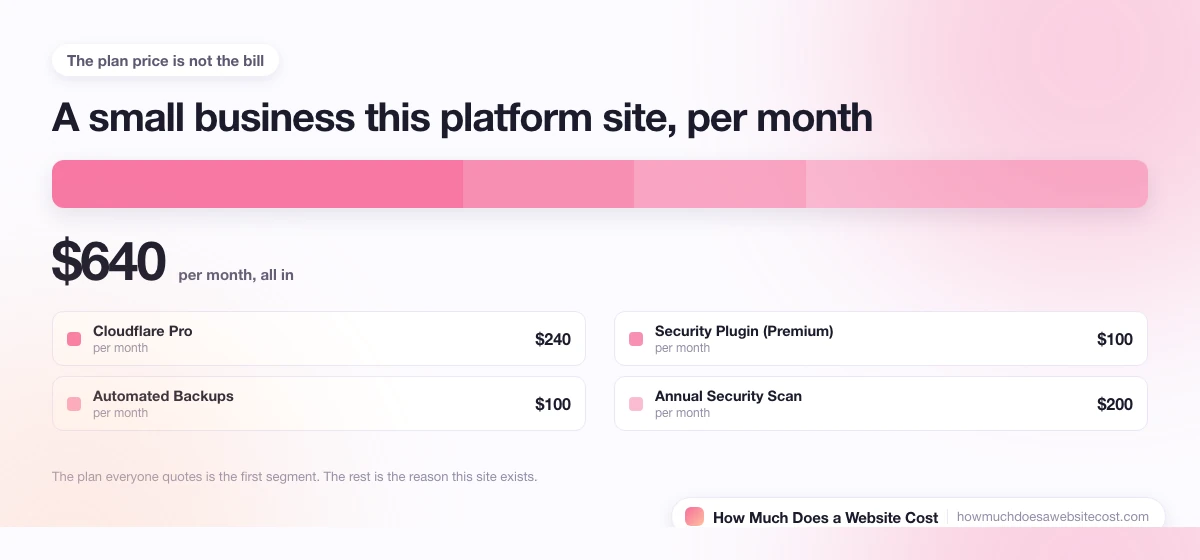
Example 2: Small Business Website ($500-$1,500/year)
| Component | Annual Cost |
|---|---|
| SSL Certificate (Included with hosting) | $0 |
| Cloudflare Pro | $240 |
| Security Plugin (Premium) | $100-$150 |
| Automated Backups | $100-$200 |
| Annual Security Scan | $200-$500 |
| Total | $640-$1,090 |
Example 3: E-commerce Website ($2,000-$5,000/year)
| Component | Annual Cost |
|---|---|
| OV SSL Certificate | $100-$200 |
| Sucuri Platform (Business) | $500 |
| Professional Backups | $300-$500 |
| Penetration Testing | $1,000-$3,000 |
| Security Monitoring | $300-$600 |
| Total | $2,200-$4,800 |
Example 4: Enterprise Website ($10,000-$50,000+/year)
| Component | Annual Cost |
|---|---|
| EV SSL Certificate | $500-$1,000 |
| Enterprise WAF | $3,000-$12,000 |
| Managed Security Services | $2,400-$6,000 |
| Comprehensive Penetration Testing | $15,000-$30,000 |
| Backup & Disaster Recovery | $1,200-$5,000 |
| Compliance Auditing | $2,000-$10,000 |
| Total | $24,100-$64,000 |
How to Reduce Website Security Costs
Start with Free SSL: Let's Encrypt provides the same encryption as paid certificates. Most hosting providers install and renew these automatically at no cost.
Use Bundled Hosting Security: Quality hosting providers include basic security features-firewalls, DDoS protection, malware scanning-in their plans. SiteGround, Kinsta, and WP Engine bundle security that would cost $200-$500/year separately.
Layer Free + Paid Services: Combine Cloudflare's free CDN and WAF with a premium security plugin. This provides comprehensive protection at a fraction of enterprise pricing.
Prioritize Based on Risk: E-commerce sites processing payments need more security investment than informational business sites. Audit your actual threat profile before buying maximum protection.
Schedule Penetration Testing Strategically: Test annually rather than quarterly unless compliance requires otherwise. Prioritize testing after major application changes.
Implement Basic Hygiene First: Strong passwords, two-factor authentication, and keeping software updated prevent most attacks without any additional cost.
Website Security Legal & Compliance Costs
| Requirement | Typical Cost | Applies To |
|---|---|---|
| PCI-DSS Compliance | $500-$50,000/year | Sites processing payments |
| HIPAA Compliance | $10,000-$100,000/year | Healthcare data |
| GDPR Compliance | $1,000-$10,000 setup | EU user data |
| SOC 2 Audit | $20,000-$100,000 | B2B SaaS companies |
| Security Policy Documentation | $500-$5,000 | Most businesses |
Compliance requirements significantly increase security costs. E-commerce sites must maintain PCI-DSS compliance, which mandates specific security controls, regular vulnerability scanning, and in some cases, quarterly penetration testing. Healthcare-related websites face even stricter HIPAA requirements.
Website Security Timeline
| Security Approach | Implementation Time | Ongoing Management |
|---|---|---|
| Basic DIY Setup | 1-2 hours | 1-2 hours/month |
| Standard Protection | 4-8 hours | 2-4 hours/month |
| Professional Security | 1-2 weeks | 4-8 hours/month |
| Enterprise Implementation | 1-3 months | Dedicated staff/team |
Most small business websites can implement adequate security within a single day. Enterprise deployments require planning, vendor evaluation, and integration with existing systems, extending timelines to weeks or months.
Is Website Security Worth the Cost?
Invest in website security if you:
- Process customer payments or sensitive data
- Face compliance requirements (PCI-DSS, HIPAA, GDPR)
- Depend on website uptime for revenue
- Store customer accounts or personal information
- Have experienced previous security incidents
- Operate in industries targeted by attackers
Consider basic protection only if you:
- Run a simple informational website
- Don't collect user data beyond contact forms
- Can tolerate occasional downtime
- Have no compliance requirements
- Accept the risk of potential cleanup costs
The average data breach costs small businesses $120,000-$150,000 including cleanup, downtime, and reputation damage. For businesses with any meaningful online revenue, annual security investments of $1,000-$5,000 represent insurance against potentially catastrophic losses.